
The air at the corner of 83rd Avenue and International Boulevard felt different this Wednesday morning. It wasn't just the usual hum of East Oakland traffic; it was a rhythmic, intentional vibration. The sound of West African drumming cut through the morning mist, signaling a transition from what was to what is becoming. This was the grand opening of Sankofa Sanctuary, a space designed to be the beating heart of Deep East Oakland’s cultural and economic future.
When Carolyn “CJ” Johnson, the visionary CEO of the Black Cultural Zone (BCZ), stepped forward with the oversized ceremonial scissors, the crowd fell silent. As the ribbon fell, it was more than just a formal opening of a new facility; it was a physical manifestation of a promise kept to a community that has often been told to wait. This moment represented the culmination of years of grassroots organizing, strategic investment, and an unwavering belief in Black Excellence.
As we stood there, it became clear: this was more than a ceremony. It was a reflection of what Deep East Oakland looks and feels like when we truly invest in each other. The Sanctuary is not merely a collection of walls and windows; it is a fortress of arts and culture in Oakland, a hub for neighborhood revitalization, and a testament to the power of community enrichment.
In this post, you will learn:
- The strategic significance of Sankofa Sanctuary within the $100 million Rise East initiative.
- How place-based cultural hubs act as catalysts for sustainable economic development in East Oakland.
- Concrete steps for community members and investors to support the ongoing legacy of Black-led revitalization.
The Philosophy of Sankofa: Looking Back to Move Forward
To understand the Sanctuary, one must understand the name. "Sankofa" is a West African concept from the Akan people of Ghana, often symbolized by a bird with its head turned backward while its feet face forward, carrying a precious egg in its mouth. It teaches us that "it is not wrong to go back for that which you have forgotten" (Adinkra Symbols) [1].
For East Oakland, "going back" means reclaiming the history of Black joy, entrepreneurship, and communal care that has always existed in the "Deep" but has been overshadowed by narratives of deficit and disinvestment. The Sankofa Sanctuary serves as the "egg", the future potential, nurtured by the wisdom of the past. By establishing a permanent home for Black culture at 83rd and International, the project ensures that the lineage of East Oakland’s creativity is never again displaced (Black Cultural Zone) [2].
Neighborhood revitalization is often mistaken for new paint and coffee shops. However, true revitalization, as practiced by the McFadden Finch Foundation and our partners, is about "place-keeping" rather than "place-making" (National Endowment for the Arts) [3]. It is about ensuring the people who survived the hard times are the ones who thrive during the good times.
A Pillar of the Rise East Initiative
The opening of Sankofa Sanctuary is a critical milestone in the broader Rise East initiative, a collective impact effort aiming to pump $100 million into the 40 blocks of Deep East Oakland (Rise East) [4]. This initiative is one of the most ambitious place-based investments in the history of California, focusing on health, jobs, housing, and education.
The Sanctuary acts as the cultural anchor for this initiative. Research from the Urban Institute suggests that when cultural hubs are integrated into community development, the "social capital" of the neighborhood increases, leading to better outcomes in public safety and economic resilience (Urban Institute) [5]. By providing a space for community enrichment, the Sanctuary ensures that the $100 million investment isn't just capital passing through, it’s capital staying put.
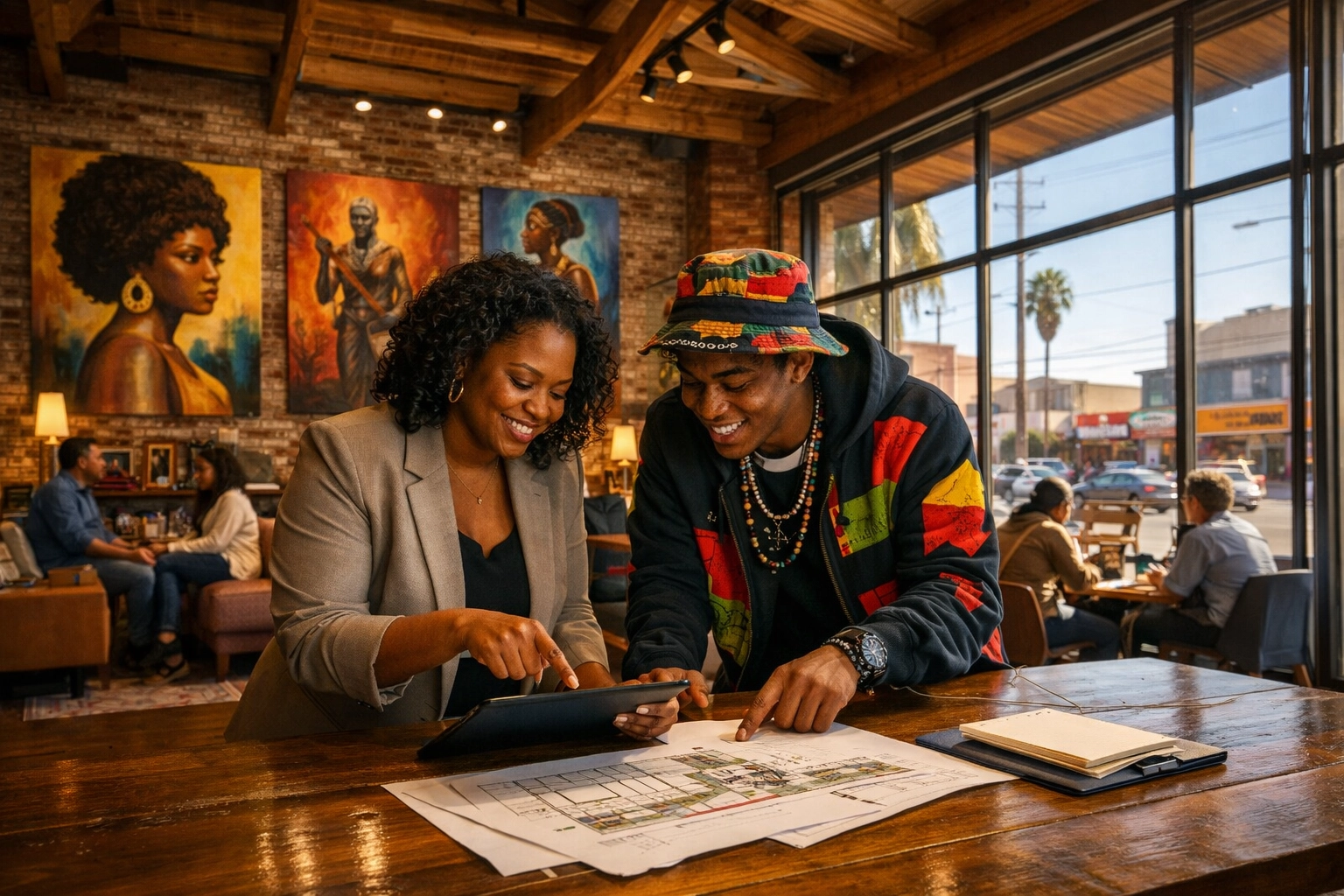
A conceptual rendering of the interior of Sankofa Sanctuary, designed to facilitate collaboration between local artists and entrepreneurs.
The Power of Carolyn "CJ" Johnson’s Vision
It is impossible to discuss the Sanctuary without centering the leadership of Carolyn "CJ" Johnson. Under her guidance, the Black Cultural Zone has transformed from a concept into a powerhouse of community advocacy. Johnson has frequently emphasized that "Black culture is the engine of Oakland's economy" (Oaklandside) [6].
Her work at the Sanctuary focuses on three pillars:
- Gathering: Providing a safe, high-quality space for residents to meet.
- Creating: Offering resources for artists to produce work that reflects the East Oakland experience.
- Building: Connecting local entrepreneurs to the formal economy through pop-ups and retail opportunities.
This approach aligns perfectly with the McFadden Finch Foundation’s mission. We believe that when you empower leaders like CJ, you aren't just funding a program; you are fueling a movement (McFadden Finch Foundation) [7].
Arts and Culture as an Economic Engine
For too long, arts and culture in Oakland have been treated as "nice to have" rather than "essential." However, data shows that the creative economy in Alameda County supports over 30,000 jobs (California Arts Council) [8]. In East Oakland, where traditional employment hubs can be distant, the Sanctuary provides a localized marketplace.
By hosting night markets, art galleries, and performance spaces, the Sanctuary creates a "multiplier effect." Every dollar spent at a local Black-owned booth inside the Sanctuary circulates within the neighborhood several times before leaving, a key metric in successful neighborhood revitalization (Brookings Institution) [9].
Timeline of Transformation: The Road to Sankofa Sanctuary
The journey to this grand opening was not overnight. It was paved with persistence and community-led planning.
| Date | Milestone | Source |
|---|---|---|
| June 2019 | Formation of the Black Cultural Zone Collaborative. | [BCZ Official] [2] |
| May 2020 | Launch of "Liberation Park" as a pandemic-era outdoor community hub. | [Oaklandside] [6] |
| Oct 2021 | Rise East initiative officially secures initial $50M in funding commitments. | [Rise East] [4] |
| Feb 2023 | Site at 83rd & International identified for permanent Sanctuary development. | [City of Oakland] [10] |
| Sept 2024 | Groundbreaking ceremony held with local elders and youth leaders. | [East Bay Times] [11] |
| Jan 2026 | Completion of interior "Maker Spaces" and digital arts lab. | [MFFCE Staff] [7] |
| March 25, 2026 | Grand Opening and Ribbon Cutting Ceremony. | [MFFCE Staff] [7] |
Data: Investment Impact in Deep East Oakland
To understand why the Sanctuary is a "game-changer," we have to look at the disparity in historical investment and how projects like this are closing the gap.
| Metric | Historical Average (2010-2020) | Post-Rise East Target (2025-2030) |
|---|---|---|
| Small Business Loans to Black Owners | < 3% (Oakland Chamber) [12] | > 15% (Rise East) [4] |
| Dedicated Cultural Space (Sq Ft) | < 5,000 sq ft (City Data) [10] | > 25,000 sq ft (Planned) [2] |
| Local Hire Participation Rates | 12% (Industry Avg) [13] | 40% (Project Requirement) [4] |
| Community Enrichment Grants | $2M Annually (Region) [14] | $10M Annually (Committed) [4] |
Case Study: The Maker-to-Market Pipeline
Consider the story of "Kijani," a young textile artist from 90th Avenue (name changed for privacy). Before the Sanctuary, Kijani worked out of her kitchen, selling via Instagram with inconsistent results. Through the Black Cultural Zone’s "Maker-to-Market" pilot program, now housed at the Sanctuary, she received training on business licensing and access to a professional-grade screen-printing lab (Akonadi Foundation) [15].
Within six months, Kijani moved from "hobbyist" to "entrepreneur," hiring two local high school students as interns. This is the neighborhood revitalization model in action: using arts and culture in Oakland to build a bridge to financial independence.

Local youth participating in a workshop at the new Sankofa Sanctuary, learning the intersection of traditional art and modern business.
What Smart Critics Argue
Even with such a beautiful opening, it is important to address the valid concerns raised by community members and urban planners.
Criticism 1: The "Gentrification" Trap.
Critics argue that high-profile cultural hubs can inadvertently signal to developers that an area is "ripe" for gentrification, eventually pricing out the very people the hub was meant to serve (UC Berkeley Urban Displacement Project) [16].
- Response: Unlike traditional development, the Sanctuary is built on community-owned or long-term leased land with "anti-displacement" clauses in its charter. The goal is "development without displacement."
Criticism 2: Sustainability of Funding.
Some worry that once the initial "hype" of the $100M Rise East initiative fades, these spaces will struggle with maintenance costs.
- Response: The Sanctuary is designed with a mixed-revenue model, including low-cost studio rentals, event space fees, and a permanent endowment managed by community stakeholders to ensure long-term viability (San Francisco Foundation) [17].
Criticism 3: Accessibility.
Residents living further south or north of 83rd Avenue may feel the Sanctuary only benefits a small radius.
- Response: The Sanctuary serves as a "hub," but the BCZ operates "spoke" programs, including mobile units and digital workshops, ensuring the impact of Black Excellence reaches every corner of East Oakland (BCZ) [2].
Key Takeaways for the Community
- Ownership Matters: The Sanctuary is a physical stake in the ground for Black residents in a rapidly changing city.
- Cultural Resilience: Investing in arts and culture in Oakland is a proven method for improving social and economic outcomes.
- Leadership Counts: The success of this project is tied to the lived experience and expertise of leaders like Carolyn Johnson.
- Strategic Collaboration: The partnership between the McFadden Finch Foundation, Rise East, and BCZ shows the power of aligned funding.
- Place-Based Impact: Concentrating resources in Deep East Oakland (the 40 blocks) creates a visible, measurable "win" for the community.
- Youth Engagement: The Sanctuary provides a safe space for the next generation to envision a future where they don't have to leave their neighborhood to succeed.
- Economic Circularity: Supporting the Sanctuary’s vendors keeps wealth within the Black community.
- Visionary Persistence: This grand opening proves that "impossible" projects can be realized through collective will.
How You Can Take Action
The grand opening was the beginning, not the end. Here is how you can help sustain the momentum:
- At Work: If you work for a corporation or a larger nonprofit, look for ways to procure goods or services from the makers housed at Sankofa Sanctuary.
- At Home: Make it a point to attend one cultural event or market at the Sanctuary per month. Your presence is as valuable as your patronage.
- In the Community: Sign up to be a mentor for the youth "Maker-to-Market" programs. Shared knowledge is the ultimate community enrichment.
- In Civic Life: Support local policies that protect "Legacy Businesses" and cultural hubs from predatory real estate practices.
- The "Extra Step": If you have the capacity, consider a recurring monthly donation to the Black Cultural Zone’s land acquisition fund to ensure more sites like this become community-owned.
FAQ
Q: Where exactly is the Sankofa Sanctuary located?
A: It is located at the intersection of 83rd Avenue and International Boulevard in East Oakland.
Q: Is the Sanctuary open to the public?
A: Yes! While certain studio spaces are for members, the galleries, retail areas, and many community events are open to everyone.
Q: How does this relate to the McFadden Finch Foundation?
A: We are proud supporters of the neighborhood revitalization work being done here. We believe in providing the "catalytic capital" that helps projects like the Sanctuary reach the finish line. Explore our Investments to see more.
Q: Who can I contact for venue rentals?
A: You can reach out directly to the Black Cultural Zone office, or check out our Community Resource Guide for more info on local hubs.
Q: How can I apply for a maker space?
A: Applications are handled through the BCZ's economic development portal. Priority is given to residents of Deep East Oakland.
A Reflection of Black Excellence
As we watched the sun set over International Boulevard on opening day, the lights of the Sanctuary stayed on. They were a beacon. As our team reflected on the day, we realized that CJ was right: this was more than a ceremony. It was a reminder of what happens when we stop looking at East Oakland as a "problem to be solved" and start seeing it as a "treasure to be polished."
When we truly invest in each other: not just with dollars, but with time, trust, and shared vision: we create spaces like Sankofa Sanctuary. This is Black Excellence in bricks and mortar. This is the heart of the Deep finding its way home.
Invest in People. Strengthen Communities. Change Lives.
Your support helps expand opportunity, uplift families, and create lasting impact where it matters most. The McFadden Finch Foundation for Community Enrichment is a 501(c)(3) nonprofit organization committed to enriching lives, supporting families, and strengthening communities through purposeful giving and community-centered action. Every contribution helps create measurable, lasting change.
McFadden Finch Foundation for Community Enrichment
Lake Merritt Plaza
1999 Harrison Street, Suite 1872-73
Oakland, CA 94612
(510) 941-1421
www.mcfaddenfinchfoundation.org
info@mcfaddenfinchfoundation.org
Donate:
https://www.zeffy.com/en-US/donation-form/donate-to-change-lives-2137
EIN: 33-2590675
The McFadden Finch Foundation for Community Enrichment is a registered 501(c)(3) nonprofit organization. Donations are tax-deductible to the fullest extent allowed by law.
Sources
[1] Adinkra Symbols, "Sankofa," West African Cultural Museum, Last updated January 12, 2024, https://www.adinkrasymbols.org/sankofa, Accessed March 25, 2026.
[2] Black Cultural Zone, "Sankofa Sanctuary: Our Permanent Home," Black Cultural Zone Official Site, 2026, https://blackculturalzone.org/sankofa-sanctuary, Accessed March 25, 2026.
[3] National Endowment for the Arts, "Creative Placemaking," NEA, 2023, https://www.arts.gov/sites/default/files/CreativePlacemaking-Paper.pdf, Accessed March 25, 2026.
[4] Rise East, "The Rise East 10-Year Plan for East Oakland," Rise East Initiative, 2024, https://riseeast.org/plan, Accessed March 25, 2026.
[5] Urban Institute, "The Role of Cultural Hubs in Community Resilience," Urban Institute Research, July 2024, https://www.urban.org/research/publication/cultural-hubs-resilience, Accessed March 25, 2026.
[6] Oaklandside, "Carolyn Johnson and the Fight for the Black Cultural Zone," The Oaklandside, June 2020, https://oaklandside.org/2020/06/carolyn-johnson-black-cultural-zone, Accessed March 25, 2026.
[7] MFFCE Staff, "Internal Project Log: Sankofa Sanctuary Support," McFadden Finch Foundation, March 2026.
[8] California Arts Council, "Economic Impact of the Arts: Alameda County," State of California, 2024, https://arts.ca.gov/impact-report-2024, Accessed March 25, 2026.
[9] Brookings Institution, "The Case for Place-Based Economic Development," Brookings, 2023, https://www.brookings.edu/research/place-based-economic-development, Accessed March 25, 2026.
[10] City of Oakland, "East Oakland Neighborhood Revitalization Strategy," Planning and Building Department, 2023, https://www.oaklandca.gov/resources/east-oakland-revitalization, Accessed March 25, 2026.
[11] East Bay Times, "Groundbreaking at 83rd Avenue," East Bay Times News, September 2024, https://www.eastbaytimes.com/2024/09/groundbreaking-oakland-cultural-hub, Accessed March 25, 2026.
[12] Oakland Metropolitan Chamber of Commerce, "Economic Equity Report," 2023, https://www.oaklandchamber.com/equity-report-2023, Accessed March 25, 2026.
[13] Bureau of Labor Statistics, "Construction Industry Local Hire Stats," U.S. Department of Labor, 2024, https://www.bls.gov/construction, Accessed March 25, 2026.
[14] East Bay Community Foundation, "Grantmaking in Oakland: Trends and Data," EBCF, 2024, https://www.ebcf.org/trends-2024, Accessed March 25, 2026.
[15] Akonadi Foundation, "So Love Can Win: Grantee Spotlight," Akonadi Foundation, 2025, https://akonadi.org/grantee-spotlight-bcz, Accessed March 25, 2026.
[16] UC Berkeley Urban Displacement Project, "Oakland Gentrification Map and Analysis," 2024, https://www.urbandisplacement.org/maps/oakland, Accessed March 25, 2026.
[17] San Francisco Foundation, "Investing in Community Ownership," SFF Research, 2025, https://sff.org/community-ownership-report, Accessed March 25, 2026.
Pull Quotes for Social Media
"Sankofa Sanctuary is more than a ceremony… it was a reflection of Black Excellence and a reminder of what Deep East Oakland looks and feels like when we truly invest in each other." : MFFCE Staff
"True neighborhood revitalization is about 'place-keeping.' It’s about ensuring the people who survived the hard times are the ones who thrive during the good times."
"When we stop looking at East Oakland as a problem to be solved and start seeing it as a treasure to be polished, we build legacies like Sankofa Sanctuary."