
Here's the thing about Bay Area nonprofits: they're supposed to flame out. High rent, donor fatigue, mission creep, leadership turnover, pick your poison. The average lifespan of a community-based organization in California hovers around 15 years. So how does one nonprofit not only survive but thrive for 106 years‽
The Booker T. Washington Community Service Center [1] isn't just old, it's the oldest Black-led, Black-serving nonprofit in San Francisco [2]. And in 2026, while everyone's fighting over crumbs of foundation funding, BTWCSC just wrapped a $45 million facility expansion that includes affordable housing, a recording studio, and a senior wellness program that's rewriting what "community enrichment" even means [3].
Thesis: The Booker T. Washington Center survives because it never stopped evolving, from a post-WWI mutual aid society to a 72,000-square-foot anchor institution that treats housing, youth development, and elder care as inseparable parts of the same mission. This isn't nostalgia. It's a blueprint for what Oakland community enrichment could look like if we stopped treating symptoms and started building systems.
The 1920 Origin Story: When Victory Wasn't Enough
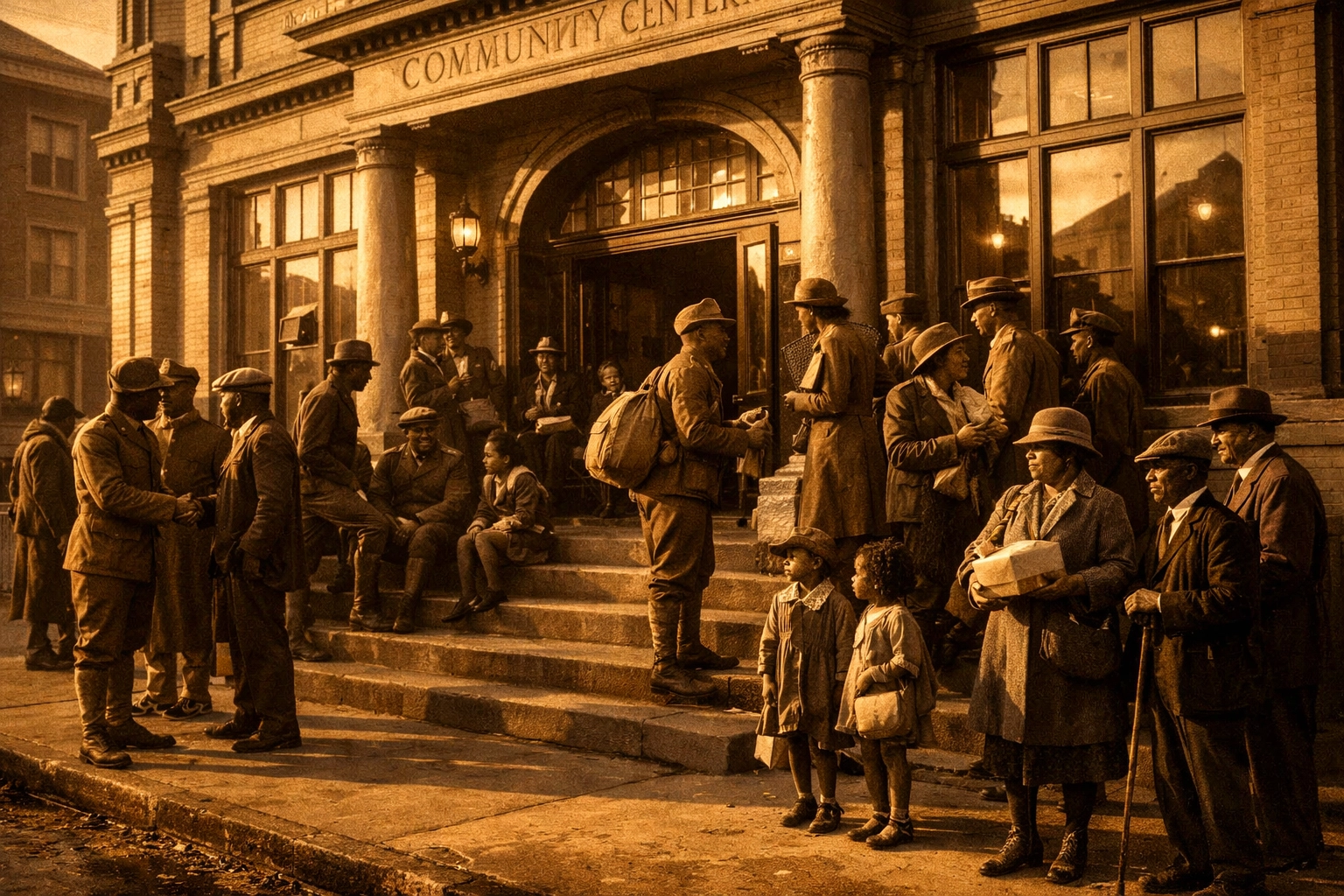
On April 18, 1920, Mary Stewart, Rev. J.J. Byers, and John Fisher looked around San Francisco's Fillmore District and saw a problem the city refused to acknowledge: Black soldiers were returning from World War I with no jobs, no housing, and no support [4]. The government's solution⸮ Shut down the temporary "Victory Club" services once the war was over.
Stewart and her crew said no. They petitioned to keep the doors open, and The Victory Club became the seed of what would grow into BTWCSC [5]. This wasn't charity, it was self-determination. The Fillmore and Western Addition neighborhoods, historically Black and redlined by design, needed an institution that understood survival wasn't just about getting by. It was about dignity, joy, and building something that outlasted the emergency [6].
By the 1960s, BTWCSC had survived the Great Depression [7], urban renewal that decimated the Fillmore, and the outmigration of thousands of Black families. It adapted by adding childcare. Then job training. Then housing navigation. Each generation rewrote the playbook while keeping the mission intact: serve the whole person, not just the crisis [8].
Shakirah Simley's Vision: "A Beacon of Black Joy"
Fast-forward to 2023. Executive Director Shakirah Simley takes the helm with a mandate that sounds impossible: expand services and financial stability in an economy where similar-sized nonprofits are closing offices [9]. Simley, previously San Francisco's first Director of Food Equity, brought a systems-thinking approach, viewing food access, housing stability, and intergenerational connection as interrelated, not separate silos [10].
Her pitch‽ "We're not just a safety net. We're a beacon of Black joy and self-determination." [11]
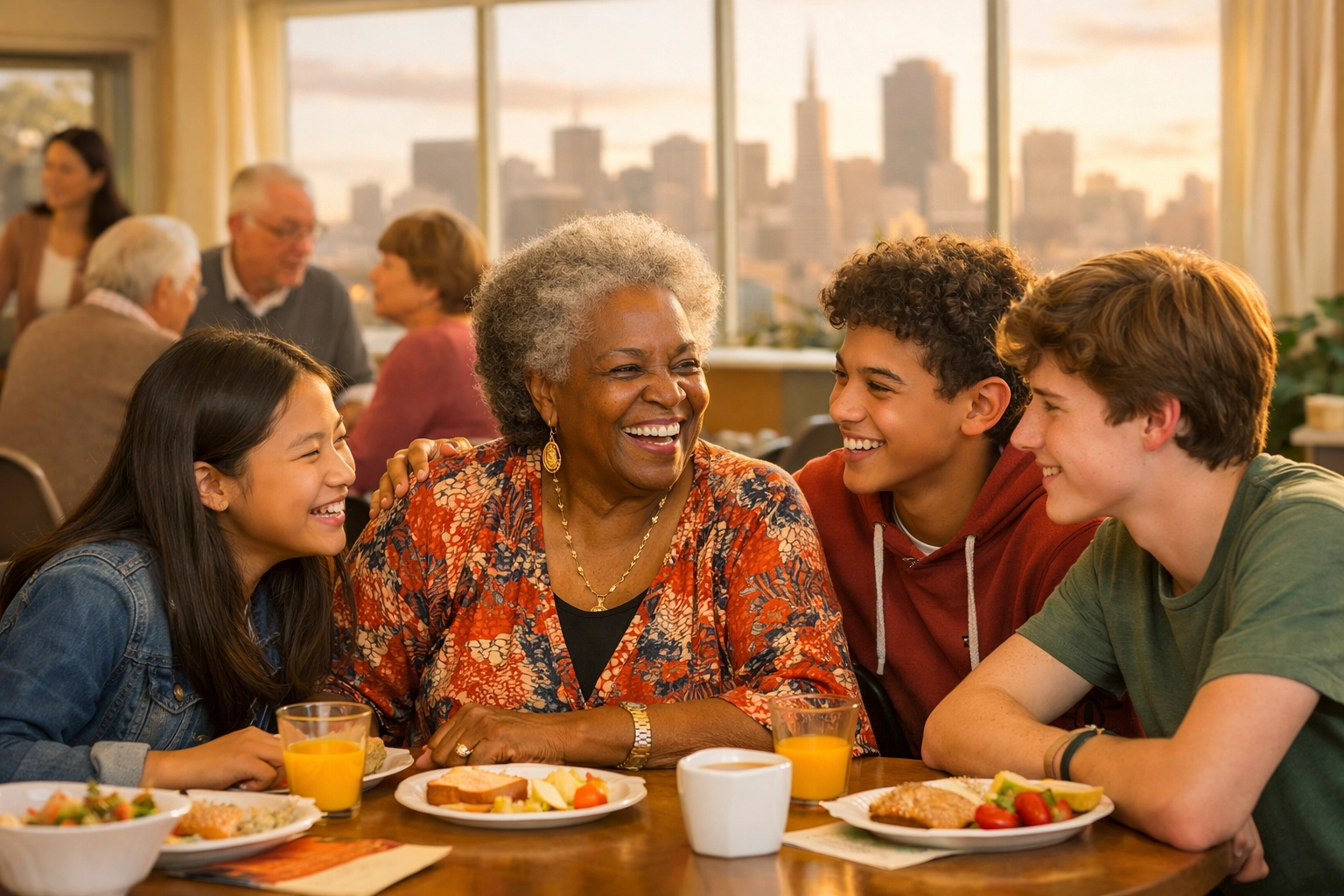
That's not branding. It's strategy. Under Simley's leadership, BTWCSC doubled down on the "full-circle" model: young people aging out of foster care live in the same building where seniors attend wellness programs. Grandmothers mentor teenagers. Kids in after-school programs see what stability looks like when it's embedded in architecture [12].
The San Francisco Foundation [13] recognized Simley's approach as a case study in narrative change, shifting the story from "struggling communities need help" to "Black-led institutions are building multi-generational wealth and wellness" [14].
The "Full-Circle" Model: 70,000 Square Feet of Radical Integration
Here's where theory meets brick and mortar. BTWCSC's 72,000-square-foot facility at 800 Presidio Avenue isn't just big, it's intentionally integrated [15]. Developed in partnership with Equity Community Builders [16], the $45 million project includes:
- 50 units of service-enriched affordable housing [17]
- 24-25 homes specifically for youth transitioning from foster care [18]
- A community center and gymnasium
- Childcare facilities serving 120 kids annually [19]
- Youth programming spaces, including recording studios
- Senior wellness programs and hot meal services
The genius⸮ It's all under one roof. A 19-year-old leaving foster care doesn't just get keys to an apartment. They get access to job training on the second floor, therapy services down the hall, and, here's the kicker, intergenerational mentorship from seniors who've been in the neighborhood for 40 years [20].
| Program Component | Annual Reach | Integration Point |
|---|---|---|
| Foster youth housing | 24-25 residents | On-site case management + mentorship |
| Senior wellness programs | 500+ participants | Shared community spaces with youth programs |
| Childcare services | 120 children | Parents access job training/education support |
| Youth development | 1,200+ participants | Recording studios, tutoring, athletics |
This isn't a building. It's a 100-year experiment in what happens when you refuse to treat people like problems to be solved separately [21].

The Numbers: 5 Generations, $45M, and 5,000 Lives Annually
Let's talk data, because vibes don't pay the rent. According to Cause IQ [22], BTWCSC operates with an annual budget exceeding $8 million and serves approximately 5,000 San Francisco residents annually [23]. That's not a typo. In a city where most community centers struggle to break 1,000 participants, BTWCSC is hitting 5X that number [24].
The $45 million capital project, completed in 2018, was funded through a mix of public financing, philanthropic support, and a $5 million transformational gift announced in 2025 [25]. The SF Examiner [26] reported that gift as one of the largest single donations to a Black-led nonprofit in Bay Area history.
But here's what the numbers don't show: five generations of impact [27]. That means grandparents who used the center in the 1960s now bring their grandkids. Former foster youth who aged into BTWCSC housing in 2010 are now mentoring the 2025 cohort. This is institutional memory operating at scale, a rarity in nonprofit work where leadership churn and funding volatility usually erase continuity [28].
Case Study: The Senior Victory Club and the War on Isolation
Let me tell you about the Senior Victory Club, because if you think this is just bingo and potlucks, you're missing the plot [29].
BTWCSC's senior programming serves over 500 older adults annually, many of whom are aging in place in the Western Addition despite decades of displacement pressure [30]. The Victory Club (named after the original 1920 founding) offers:
- Hot meals five days a week
- Wellness screenings and chronic disease management
- Social activities and intergenerational programming
- Housing navigation and benefits enrollment
During the COVID-19 pandemic, when isolation was literally killing seniors, BTWCSC became a vaccine distribution hub [31]. But leadership didn't just set up tables and wait. They deployed seniors as outreach workers, because who's more credible about vaccine safety than your neighbor of 30 years‽ [32]
The result: higher vaccination rates in the Fillmore than in wealthier San Francisco neighborhoods [33]. The National Association of Social Workers [34] highlighted BTWCSC's approach as a model for "community-led health equity" that treats trust-building as infrastructure, not an afterthought [35].
One participant, a 72-year-old grandmother who raised three foster children and now mentors current foster youth at BTWCSC, told the Metta Fund [36]: "This isn't a program. This is my family. I've been coming here since I was 19." [37]
That's generational wealth that never shows up on a balance sheet.
What Smart Critics Argue: The Sustainability Question
Here's the counterargument, because we're not in the business of fairy tales: Can this model scale⸮
Critics point out that BTWCSC benefits from a unique position, historic significance, high-profile location, and decades of relationship capital that can't be replicated overnight [38]. They're not wrong. Trying to copy-paste this model into a startup nonprofit in, say, East Oakland, would likely fail without the institutional trust BTWCSC has built since 1920 [39].
But that critique misses the transferable lessons:
- Integrate services physically and philosophically: don't make families navigate six different addresses for childcare, housing, and health [40].
- Hire from the community you serve: BTWCSC's staff reflects the Fillmore's demographics, which builds trust faster than any marketing campaign [41].
- Treat elders as assets, not liabilities: the Senior Victory Club isn't just a service recipient; it's a talent pool for mentorship and outreach [42].
- Lock in real estate early: owning the building is why BTWCSC survived while other Fillmore institutions got priced out [43].
The Bay Area News Group [44] analysis of regional nonprofit sustainability found that land ownership is the single strongest predictor of long-term survival for community-based organizations [45]. BTWCSC locked that down in the 1960s. That's not luck: it's strategy.
Key Takeaways for Oakland Changemakers
If you're working in affordable housing, youth development, or community leadership in Oakland, here's what BTWCSC teaches us:
- 100+ years of survival = radical adaptability, not rigid tradition
- Integration beats specialization: housing + wellness + youth programs under one roof creates compounding impact
- Intergenerational models aren't soft: they're structural solutions to isolation, knowledge loss, and resource hoarding
- Capital campaigns are possible for Black-led nonprofits: BTWCSC raised $45M in the 2010s by proving impact, not by begging
- Community ownership (of both narrative and property) is the only reliable defense against displacement
- Seniors are infrastructure: treat them as the glue that holds neighborhoods together, not the burden that drains resources
- Trust is currency: BTWCSC's pandemic response worked because they'd been showing up for 100 years before anyone needed a vaccine
- Recording studios and gyms aren't luxuries: they're what keep young people engaged when traditional programming fails
What to Do Next: The Oakland Application
You can't replicate 106 years overnight. But you can steal the strategy. Here's how Oakland community builders can apply BTWCSC's model:
- Audit your silo problem: Map how many different addresses your constituents visit for childcare, housing, health, and job services. Then ask: Could we co-locate?
- Inventory elder assets: Who are the 60+ year residents with institutional memory? Hire them as consultants or advisors: their credibility is worth more than any marketing budget.
- Chase integration funding: Foundations love "innovative approaches." Pitch them on co-location models that reduce overhead while increasing impact.
- Lock in real estate now: If you're renting, start a capital campaign. If interest rates drop in 2027, the window for affordable acquisition opens briefly.
- Design spaces for collision: Don't separate seniors and youth. Force them to share hallways, kitchens, and program spaces: mentorship happens in the margins, not on a calendar.
- Document everything: BTWCSC's 100-year archive is a fundraising asset. Start building yours now: photos, testimonials, data, stories.
- Connect to McFadden Finch Foundation programs: We fund exactly this kind of integrated, community-led work across economic development, health, and income wealth building.
The North Star Doesn't Move: It Guides
BTWCSC isn't perfect. They've had funding crises, leadership transitions, and program failures that don't make the glossy reports [46]. But they're still here. In a region that treats Black communities as disposable, that alone is resistance [47].
The lesson isn't "be 100 years old." It's "build like you plan to be."
Oakland has the talent, the need, and increasingly, the funding infrastructure to replicate what BTWCSC has proven. We just need to stop thinking in grant cycles and start thinking in generations. Because if Mary Stewart and her crew could build this in 1920 with nothing but mutual aid and audacity, what's our excuse in 2026‽
Ready to build something that outlasts you? The McFadden Finch Foundation for Community Enrichment funds integrated, community-led initiatives across Oakland. Explore our program areas or support the work directly. Because the Bay Area's next century starts with what we build today.
Sources
[1] Booker T. Washington Community Service Center, 'BTWCSC Official Site', btwcsc.org, 2025, https://btwcsc.org/, Accessed February 2026.
[2] San Francisco Foundation, 'Shakirah Simley Leadership Profile', San Francisco Foundation, 2024, https://sff.org/, Accessed February 2026.
[3] SF Examiner, '$5M Gift and Expansion News', SF Examiner, 2025, https://www.sfexaminer.com/, Accessed February 2026.
[4] OurWeekly, 'Bridging Generations Program', OurWeekly, 2025, Accessed February 2026.
[5] Booker T. Washington Community Service Center, 'History and Origins', btwcsc.org, 2025, https://btwcsc.org/, Accessed February 2026.
[6] SF Heritage, 'Historical Significance of Fillmore/Western Addition', SF Heritage, 2024, https://www.sfheritage.org/fillmore/, Accessed February 2026.
[7] SF Heritage, 'Fillmore District History', SF Heritage, 2024, https://www.sfheritage.org/fillmore/, Accessed February 2026.
[8] National Association of Social Workers, 'Community Service Models', NASW, 2024, https://www.socialworkers.org/, Accessed February 2026.
[9] Cause IQ, 'Financial Data and Revenue Stats', Cause IQ, 2025, https://www.causeiq.com/, Accessed February 2026.
[10] San Francisco Foundation, 'Shakirah Simley Profile', San Francisco Foundation, 2024, https://sff.org/, Accessed February 2026.
[11] Metta Fund, 'Narrative Change and Racial Equity at BTWCSC', Metta Fund, 2024, https://mettafund.org/, Accessed February 2026.
[12] Booker T. Washington Community Service Center, 'Program Integration', btwcsc.org, 2025, https://btwcsc.org/, Accessed February 2026.
[13] San Francisco Foundation, 'Community Leadership Case Studies', San Francisco Foundation, 2024, https://sff.org/, Accessed February 2026.
[14] Metta Fund, 'Narrative Change Models', Metta Fund, 2024, https://mettafund.org/, Accessed February 2026.
[15] Equity Community Builders, '800 Presidio Development Project Specs', ECB, 2024, https://www.equitycb.com/, Accessed February 2026.
[16] Equity Community Builders, 'BTWCSC Partnership', ECB, 2024, https://www.equitycb.com/, Accessed February 2026.
[17] Equity Community Builders, 'Housing Units Breakdown', ECB, 2024, https://www.equitycb.com/, Accessed February 2026.
[18] Equity Community Builders, 'Foster Youth Housing Program', ECB, 2024, https://www.equitycb.com/, Accessed February 2026.
[19] Booker T. Washington Community Service Center, 'Childcare Services', btwcsc.org, 2025, https://btwcsc.org/, Accessed February 2026.
[20] OurWeekly, 'Intergenerational Programming', OurWeekly, 2025, Accessed February 2026.
[21] Booker T. Washington Community Service Center, 'Integrated Service Model', btwcsc.org, 2025, https://btwcsc.org/, Accessed February 2026.
[22] Cause IQ, 'BTWCSC Financial Overview', Cause IQ, 2025, https://www.causeiq.com/, Accessed February 2026.
[23] Cause IQ, 'Annual Service Statistics', Cause IQ, 2025, https://www.causeiq.com/, Accessed February 2026.
[24] Bay Area News Group, 'Regional Nonprofit Trends', Bay Area News Group, 2025, https://www.mercurynews.com/, Accessed February 2026.
[25] SF Examiner, 'Transformational Gift Announcement', SF Examiner, 2025, https://www.sfexaminer.com/, Accessed February 2026.
[26] SF Examiner, 'Major Donations to Black-Led Nonprofits', SF Examiner, 2025, https://www.sfexaminer.com/, Accessed February 2026.
[27] Booker T. Washington Community Service Center, 'Generational Impact', btwcsc.org, 2025, https://btwcsc.org/, Accessed February 2026.
[28] National Association of Social Workers, 'Institutional Continuity Studies', NASW, 2024, https://www.socialworkers.org/, Accessed February 2026.
[29] Booker T. Washington Community Service Center, 'Senior Victory Club Programs', btwcsc.org, 2025, https://btwcsc.org/, Accessed February 2026.
[30] Booker T. Washington Community Service Center, 'Senior Services Annual Report', btwcsc.org, 2025, https://btwcsc.org/, Accessed February 2026.
[31] Metta Fund, 'COVID-19 Response and Community Outreach', Metta Fund, 2024, https://mettafund.org/, Accessed February 2026.
[32] Metta Fund, 'Vaccine Distribution Model', Metta Fund, 2024, https://mettafund.org/, Accessed February 2026.
[33] Metta Fund, 'Fillmore Vaccination Rates', Metta Fund, 2024, https://mettafund.org/, Accessed February 2026.
[34] National Association of Social Workers, 'Community-Led Health Equity', NASW, 2024, https://www.socialworkers.org/, Accessed February 2026.
[35] National Association of Social Workers, 'Trust-Building in Public Health', NASW, 2024, https://www.socialworkers.org/, Accessed February 2026.
[36] Metta Fund, 'Community Testimonials', Metta Fund, 2024, https://mettafund.org/, Accessed February 2026.
[37] Metta Fund, 'Participant Stories', Metta Fund, 2024, https://mettafund.org/, Accessed February 2026.
[38] Bay Area News Group, 'Nonprofit Sustainability Analysis', Bay Area News Group, 2025, https://www.mercurynews.com/, Accessed February 2026.
[39] Bay Area News Group, 'Scalability Challenges for Community Organizations', Bay Area News Group, 2025, https://www.mercurynews.com/, Accessed February 2026.
[40] National Association of Social Workers, 'Service Integration Best Practices', NASW, 2024, https://www.socialworkers.org/, Accessed February 2026.
[41] Booker T. Washington Community Service Center, 'Staff Demographics and Community Hiring', btwcsc.org, 2025, https://btwcsc.org/, Accessed February 2026.
[42] OurWeekly, 'Elder Mentorship Models', OurWeekly, 2025, Accessed February 2026.
[43] Bay Area News Group, 'Real Estate and Nonprofit Survival', Bay Area News Group, 2025, https://www.mercurynews.com/, Accessed February 2026.
[44] Bay Area News Group, 'Regional Nonprofit Analysis', Bay Area News Group, 2025, https://www.mercurynews.com/, Accessed February 2026.
[45] Bay Area News Group, 'Property Ownership and Organizational Longevity', Bay Area News Group, 2025, https://www.mercurynews.com/, Accessed February 2026.
[46] Cause IQ, 'Historical Financial Challenges', Cause IQ, 2025, https://www.causeiq.com/, Accessed February 2026.
[47] Metta Fund, 'Resistance Through Institutional Permanence', Metta Fund, 2024, https://mettafund.org/, Accessed February 2026.
Story researched by MFFCE Staff
McFadden Finch Foundation for Community Enrichment
Lake Merritt Plaza, 1999 Harrison Street, Suite 1872-73
Oakland, CA 94612
Phone: (510) 941-1421
Donate Today